
Injection moulding vs CNC machining is an important manufacturing decision for OEM buyers, product development engineers and industrial procurement teams. Selecting the wrong process can increase manufacturing costs, delay product development or result in unnecessary tooling expenditure.
Both processes manufacture functional components, but they use fundamentally different methods. Injection moulding forms plastic parts inside a mould, while CNC machining removes material from a solid workpiece to achieve the required geometry.
The right choice depends on component design, material requirements, dimensional tolerances, expected production volume and long-term supply plans.
This guide explains the practical differences, costs, advantages and limitations of both methods to help engineering buyers make informed manufacturing decisions.
Injection Moulding vs CNC Machining: Understanding the Difference
Before comparing quotations, buyers should understand how each manufacturing process works.
Although both methods can produce plastic components, their equipment, manufacturing steps and cost structures differ significantly.
What Is Plastic Injection Moulding?
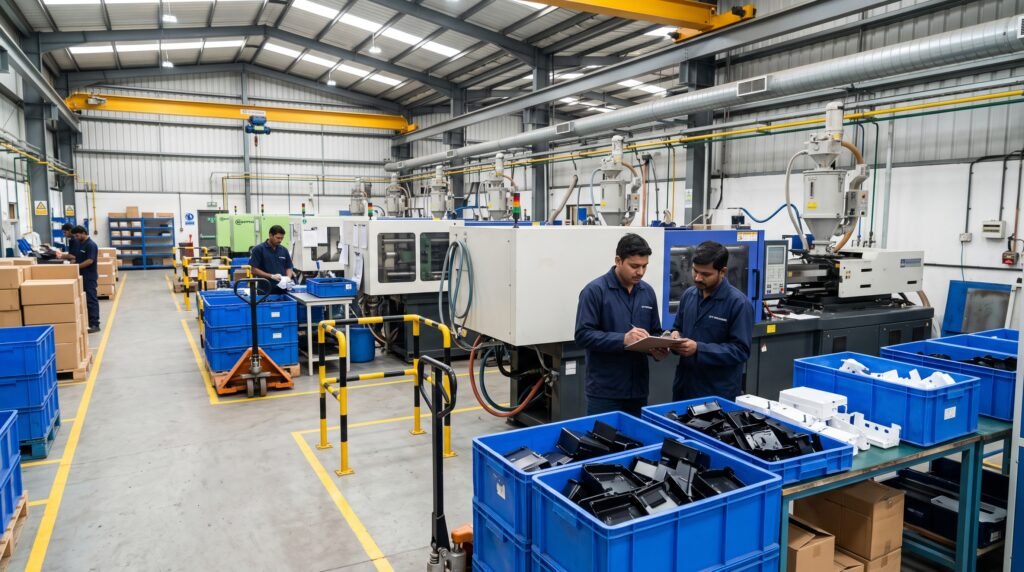
Plastic injection moulding is a manufacturing process in which polymer material is heated, injected into a mould cavity and allowed to cool and solidify into the required shape.
After cooling, the mould opens and the finished component is ejected.
The process is commonly used for repeat manufacturing of plastic components where suitable tooling can be developed or is already available.
Typical applications include industrial housings, caps, fittings, connectors and customised OEM plastic components.
Injection moulding can be economically attractive for recurring production because a mould can produce repeated parts without machining each complete shape from solid stock.
However, mould development requires an initial investment, and design changes may require tooling modifications.
What Is CNC Machining?
Computer Numerical Control (CNC) machining uses computer-controlled equipment to remove material from a solid workpiece.
Depending on the equipment, machining operations may include turning, milling, drilling and boring.
CNC machining can produce components from suitable plastics and metals. It is frequently considered for prototypes, specialised components and applications where direct machining from stock is appropriate.
Unlike injection moulding, CNC machining generally does not require a dedicated injection mould for every component design.
However, machining costs depend on programming, setup, machine time, material consumption and component complexity.
How Each Process Produces a Finished Component
The main distinction in injection moulding vs CNC machining is the method used to create the final shape.
Injection moulding forms material within a prepared cavity, while CNC machining removes material from a larger workpiece.
Both processes may require additional operations, inspection or finishing depending on the component.
Why Component Geometry Matters
Component geometry affects process suitability.
Injection moulding requires consideration of mould filling, cooling, draft angles, wall thickness and part ejection.
CNC machining requires consideration of cutting-tool access, workholding, internal features and the sequence of machining operations.
Confirming the Final Design Before Production
Before choosing a manufacturing process, confirm the component drawing, material specification, critical dimensions, inspection requirements and expected production quantities.
A manufacturability review can identify issues before tooling investment or production planning begins.
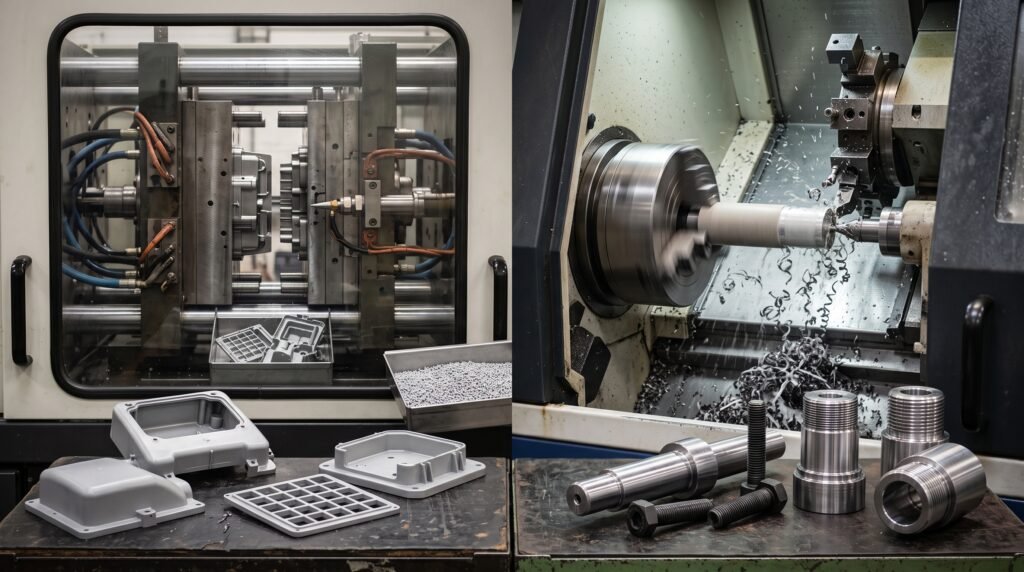
CNC vs Injection Molding: Key Manufacturing Differences
A detailed injection moulding vs CNC machining comparison helps buyers identify the process that best matches their project requirements.
| Evaluation Factor | Injection Moulding | CNC Machining |
|---|---|---|
| Manufacturing method | Forms molten plastic inside a mould | Removes material from solid stock |
| Initial investment | Often requires dedicated mould tooling | Generally requires programming and setup rather than a mould |
| Unit cost | Can be economical for repeat production | Depends heavily on machining time and complexity |
| Prototypes | May require prototype tooling | Often suitable for early functional prototypes |
| Small batches | Depends on available tooling and economics | Often attractive for limited quantities |
| Large quantities | Frequently advantageous for repeat plastic parts | May remain appropriate for specialised components |
| Design changes | May require mould modifications | Often implemented through revised programs and setups |
| Materials | Requires suitable moulding-grade polymers | Can use machinable plastics and metals |
| Tolerances | Depends on material, tooling and process control | Depends on equipment, material and machining setup |
| Material waste | Typically includes runners, sprues, rejects and other process waste | Produces chips and offcuts through material removal |
| Surface finish | Influenced by mould surface and process conditions | Influenced by machining operations and tooling |
| Repeat production | Suited to consistent production using approved tooling | Suited to repeat production with controlled setups |
Neither process is universally superior.
The most appropriate choice depends on component requirements, production volume and total manufacturing cost.
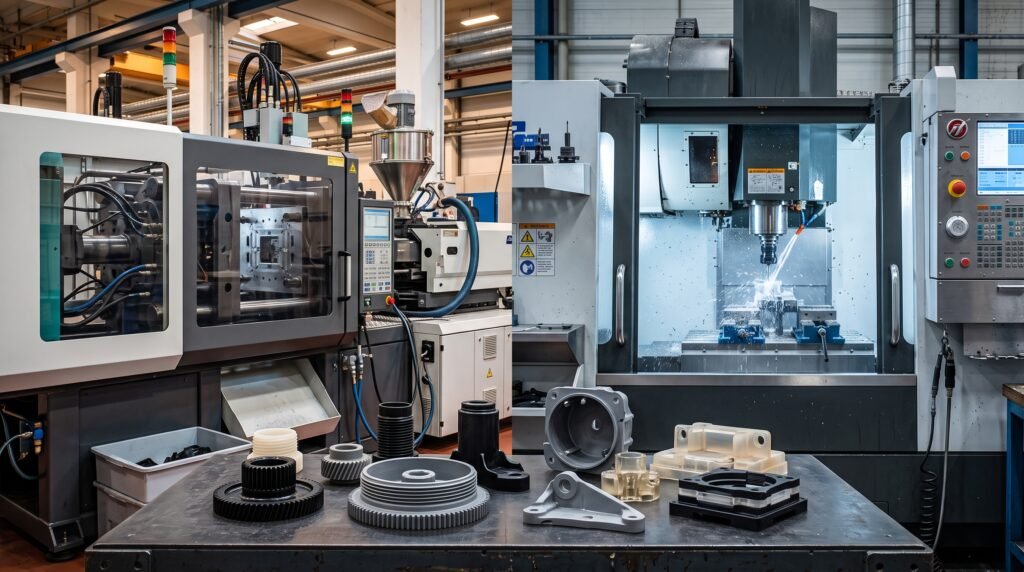
Injection Moulding vs CNC Machining: Cost Comparison
Cost is often the deciding factor in injection moulding vs CNC machining, particularly for OEM buyers planning recurring production.
However, comparing only the quoted price per component can lead to misleading conclusions.
Buyers should evaluate upfront expenditure, recurring manufacturing costs and expected lifetime demand.
Initial Tooling Costs
Injection moulding generally requires a mould designed for the component.
Tooling costs depend on component complexity, cavity configuration, mould materials, expected production requirements and other technical factors.
The initial investment can be significant, but it may be distributed across many production units.
CNC Setup and Machining Costs
CNC machining typically involves programming, tooling selection, workholding and machine setup.
The recurring cost depends on machining time, component complexity, raw material requirements and inspection activities.
For prototypes or small batches, avoiding dedicated mould development may offer an economic advantage.
Cost Per Component at Different Production Volumes
A simplified manufacturing cost comparison can be expressed as follows:
Injection moulding total cost = Tooling cost + (Moulded unit cost × Quantity)
CNC machining total cost = Setup cost + (Machined unit cost × Quantity)
These simplified formulas exclude some possible expenses, including engineering changes, maintenance, inspection and logistics.
Injection moulding may have a higher initial investment but a lower recurring unit cost. CNC machining may involve a lower initial commitment but a higher cost per component.
The economic crossover depends on actual quotations and the anticipated quantity.
When evaluating injection moulding vs CNC machining, request quotations based on identical component specifications and realistic production volumes.
Plastic Machining vs Moulding: Materials and Design Considerations
Material selection is another major factor in injection moulding vs CNC machining.
Although some polymer families are available in both moulding and machining forms, the available grades and resulting component properties may differ.
Buyers should not assume that a machined prototype and an injection-moulded production component will perform identically.
Material Properties
Evaluate mechanical strength, chemical resistance, temperature requirements, dimensional stability and intended operating conditions.
Confirm that the selected material grade is suitable for the proposed manufacturing process.
Design and Geometry
Injection moulding may be appropriate for complex repeated plastic shapes when the geometry can be moulded and ejected successfully.
CNC machining can be attractive when a design requires frequent changes or when the component geometry is accessible to cutting tools.
However, difficult internal features may increase machining complexity.
Dimensional Accuracy
Both methods can manufacture dimensionally controlled components.
Actual achievable tolerances depend on the material, equipment, tooling, component geometry and process conditions.
Therefore, the injection moulding vs CNC machining decision should consider the specific dimensions that affect the component’s function.
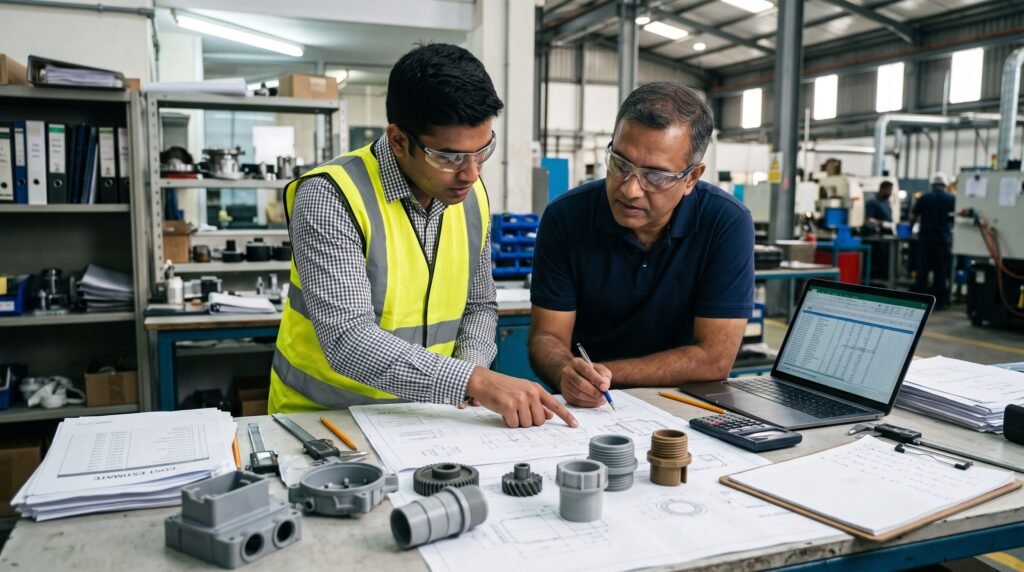
Which Process Is Better for Prototypes and Small Batches?
During product development, engineers often need functional samples before committing to full production.
CNC machining may be suitable because components can be produced directly from available material stock without first manufacturing a dedicated injection mould.
This can support design evaluation and changes during early development.
However, a machined prototype may not fully represent the behaviour of an injection-moulded component.
For example, material properties, residual stresses, surface characteristics and manufacturing-related features may differ.
Injection moulding can also be suitable for pilot production where appropriate tooling is already available.
For injection moulding vs CNC machining in prototype development, consider the purpose of the sample rather than only its price.
A prototype intended to evaluate assembly dimensions may have different requirements from a sample intended to validate production material behaviour.
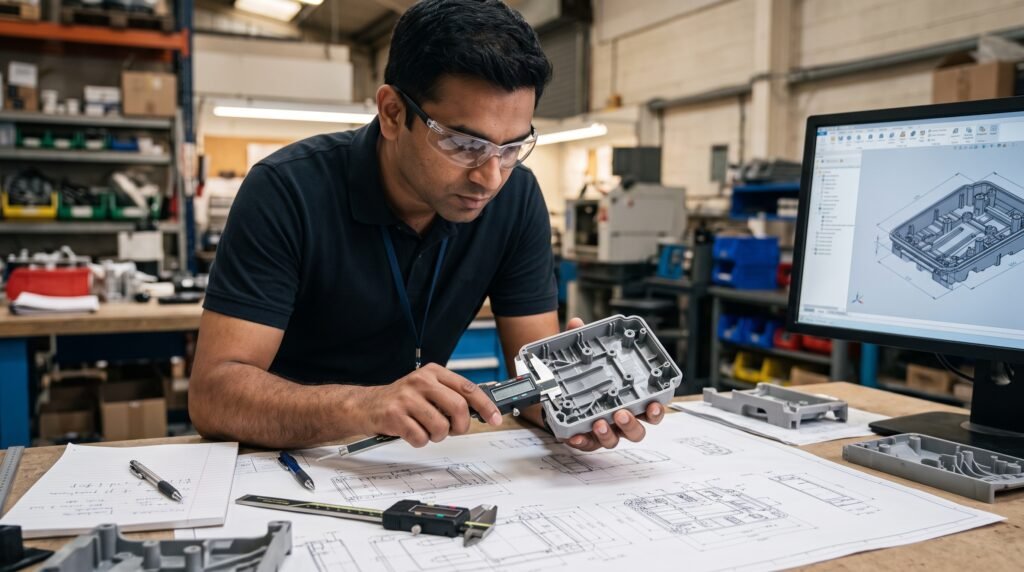
Which Process Is Better for OEM and Bulk Production?
OEM buyers frequently require repeatable component production across multiple purchase orders.
Injection moulding may become economically attractive when component specifications are stable and anticipated production quantities justify the tooling investment.
Once approved tooling and production parameters are established, the process can support repeated manufacture of suitable plastic components.
CNC machining may remain appropriate for specialised components, lower-volume requirements or designs that are not economically suited to injection moulding.
The injection moulding vs CNC machining decision should therefore consider lifetime demand rather than only the initial purchase order.
Consider Future Demand
Ask whether production quantities are expected to increase.
If the component will be required repeatedly over several years, tooling investment may be evaluated against anticipated long-term savings.
Consider Design Stability
A stable design is important when committing to production tooling.
If substantial design changes are expected, machining may provide greater flexibility during development.
Consider Supply Planning
Discuss material availability, manufacturing lead times, inspection requirements and repeat-order scheduling with prospective suppliers.
The best process must support both component quality and practical supply requirements.
Manufacturing Process Comparison: Practical Buyer Checklist
Before approving a supplier, use this injection moulding vs CNC machining checklist to evaluate your project.
| Buyer Question | Why It Matters |
|---|---|
| What material is required? | Determines process and grade suitability |
| What is the expected annual quantity? | Influences manufacturing economics |
| Is the component design final? | Affects tooling investment risk |
| Are functional prototypes required? | Helps determine the development approach |
| What tolerances are critical? | Guides technical feasibility |
| Is the geometry suitable for moulding? | Identifies tooling and ejection constraints |
| Is the geometry accessible for machining? | Identifies cutting and workholding challenges |
| What is the available tooling budget? | Influences upfront investment |
| What is the target unit cost? | Supports commercial evaluation |
| What delivery schedule is required? | Affects production planning |
| Will repeat orders be placed? | Influences long-term process economics |
| Are special inspections required? | Affects quality planning and costs |
Quick Process Selection Guide
Choose CNC machining for further evaluation when:
- You require early prototypes or limited quantities.
- The component design may change frequently.
- Dedicated injection mould tooling is not economically justified.
- The material and geometry are suitable for machining.
Choose injection moulding for further evaluation when:
- You require recurring production of suitable plastic components.
- The component design is sufficiently stable.
- Expected quantities may justify tooling investment.
- Consistent production using approved tooling is required.
These are general guidelines. Final process selection should follow a technical and commercial assessment.
Common Mistakes When Comparing Manufacturing Processes
Several sourcing mistakes can affect the outcome of injection moulding vs CNC machining decisions.
Comparing Only Unit Prices
A unit quotation does not always include tooling, setup, sampling or inspection costs.
Compare the complete commercial arrangement.
Ignoring Lifetime Production Volume
A process that is economical for a small order may not be the most economical for substantial repeat production.
Evaluate anticipated lifetime demand.
Assuming Materials Are Identical
Machining stock and moulding-grade materials may differ in availability, grade and resulting properties.
Verify material suitability.
Overlooking Manufacturing Constraints
Complex geometry may create moulding or machining difficulties.
Request a technical review before finalising the process.
Skipping Sample Approval
Samples should be assessed against agreed specifications before regular production begins.
Document any changes and approvals.
Choosing a Supplier Without Checking Capabilities
Not every manufacturer provides the same processes, tooling arrangements or inspection facilities.
Confirm project-specific suitability before issuing a purchase order.
How SVV Moulders Supports Manufacturing Discussions
SVV Moulders is a plastic injection moulding manufacturer based in Nagaram, Rangareddy District, Telangana, India.
The company manufactures plastic injection-moulded components for industrial and OEM requirements based on customer drawings, samples and specifications.
Its stated manufacturing activities also include CNC automatic lathe-machined hydraulic components.
However, CNC automatic lathe machining should not be confused with every category of CNC milling, routing or general-purpose plastic machining.
Buyers considering injection moulding vs CNC machining can discuss their requirements with SVV Moulders to establish whether the company’s available manufacturing capabilities are suitable for their project.
For a productive discussion, provide your component drawing, material requirements, expected quantities, critical dimensions and anticipated delivery schedule.
Contact SVV Moulders for Process Guidance
Have a component drawing or sample?
Discuss your manufacturing requirements with SVV Moulders before committing to tooling or production.
Website: https://svvmolders.com/
Contact: https://svvmolders.com/contact/
Phone / WhatsApp: +91 93925 03136
Frequently Asked Questions
1. Is injection moulding cheaper than CNC machining?
Injection moulding may offer lower recurring unit costs for sufficiently large production quantities, but it generally requires an initial mould investment. CNC machining may be more economical for small quantities or frequently changing designs. Actual costs depend on the component and quotations.
2. Which process is better for low-volume plastic components?
CNC machining is often suitable for low-volume components because it can avoid dedicated mould development. However, injection moulding may also be appropriate if suitable tooling already exists.
3. Is CNC machining more accurate than injection moulding?
Neither process is universally more accurate. Achievable tolerances depend on the material, component geometry, machinery, tooling and process controls. Buyers should discuss critical dimensions with the manufacturer.
4. Can the same plastic material be machined and injection moulded?
Some polymer families are available in grades suitable for both processes, but material form, grade and properties may differ. Confirm the specific material requirements rather than assuming direct equivalence.
5. When should an OEM invest in injection moulding tooling?
An OEM should consider tooling investment when the component design is sufficiently stable and anticipated production quantities justify the upfront cost. Technical feasibility and expected lifetime demand should guide the decision.
6. How can SVV Moulders help evaluate manufacturing requirements?
SVV Moulders can discuss relevant plastic injection moulding requirements using customer drawings, samples, material specifications and expected quantities. Its CNC automatic lathe capabilities should be assessed separately for project-specific suitability.
11. Conclusion: Choosing the Right Manufacturing Process
The choice between injection moulding vs CNC machining depends on more than manufacturing cost.
Injection moulding is often attractive for repeat plastic component production when tooling investment is justified. CNC machining may offer advantages for prototypes, limited quantities, design changes and certain specialised components.
Before making a decision, review component geometry, material requirements, dimensional tolerances, production quantities, tooling costs and delivery expectations.
A technical manufacturing discussion can help identify practical constraints and clarify the next steps.
Contact SVV Moulders for process guidance and share your drawings or component specifications for a manufacturing capability discussion.
Website: https://svvmolders.com/
Phone / WhatsApp: +91 93925 03136