
For buyers sourcing in Hyderabad, Telangana or elsewhere in India, OEM injection moulding should be evaluated through more than the question, “Can this part be moulded?” A useful sourcing review should establish what the component must do, which dimensions are critical, what material is required, what quantities are expected and how repeat production will be checked. This approach aligns the purchasing decision with manufacturability, material choice and process requirements rather than treating all quotations as technically identical.
For buyers comparing plastic component manufacturing partners, OEM injection moulding requires a productive commercial discussion that combines technical and purchasing information. The component drawing, application, material requirement, critical dimensions, expected demand, packaging needs, approval method and engineering-change expectations should ideally be established before quotations are compared.
Sampling is where design intent meets the actual manufacturing process, and in OEM injection moulding, this stage is essential for confirming whether tooling and processing can produce the required result. Initial components should be reviewed against agreed dimensions, fit, appearance and functional requirements, with deviations recorded and corrective actions controlled. Once the sample is approved, both parties should be clear about which drawing revision, material specification and inspection criteria form the production baseline.
Procurement teams should also ask how an OEM injection moulding supplier manages material identification, drying where required, start-up conditions, in-process checks, mould condition and final inspection. The purpose is not to demand unnecessary paperwork; it is to establish whether the manufacturing controls are appropriate for the technical and commercial risk associated with the component.
Repeat orders are where OEM injection moulding process discipline becomes especially important. Production should work from the current approved drawing and material requirement, while procurement should reference the correct revision and communicate important quantity or schedule changes. Maintaining this technical baseline helps reduce ambiguity across future manufacturing batches.
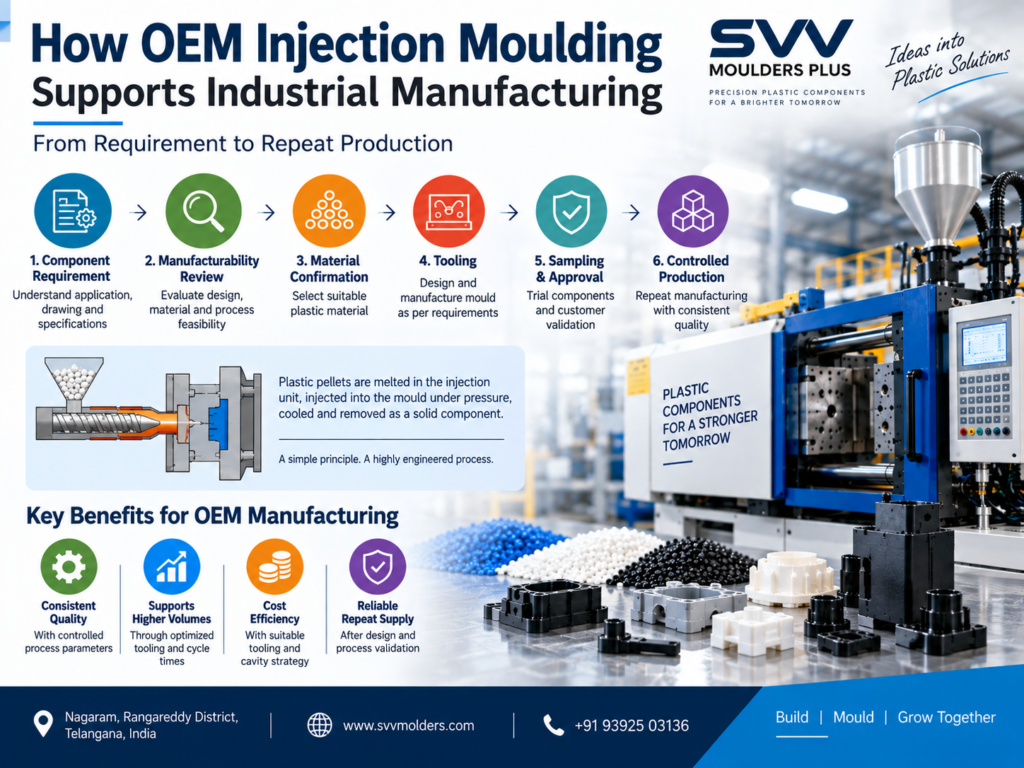
How OEM Injection Moulding Supports Industrial Manufacturing
A typical OEM injection moulding project moves from a defined component requirement through manufacturability review, material confirmation, tooling, sampling, approval and controlled production. Injection moulding uses an injection unit, mould and clamping system; plastic pellets are melted, injected into the mould, cooled and removed as a solid component.
For an OEM, OEM injection moulding supports repeat production after the component design, tooling and manufacturing process have been validated. However, repeatability should not be assumed automatically. Gate design, melt and mould temperatures, injection speed, packing conditions and cooling can influence material flow, shrinkage and final component condition, so stable output depends on appropriate tooling and process control.
Production volume also changes the sourcing conversation in OEM injection moulding. Expected batch or annual quantities can influence tooling economics, cavity strategy, material planning, inspection requirements and production scheduling. Buyers should therefore communicate expected quantities early so that manufacturing requirements can be evaluated alongside component design and quality expectations.
For buyers comparing plastic component manufacturing partners, OEM injection moulding requires both technical and commercial information to be reviewed together. The component drawing, application, material requirement, critical dimensions, expected demand, packaging needs, approval method and engineering-change expectations should ideally be established before quotations are compared.
This approach helps procurement teams evaluate OEM injection moulding suppliers on a more consistent basis. A lower unit quotation may not represent the better commercial outcome if tooling scope, inspection requirements, secondary operations, material expectations or repeat-production requirements differ between suppliers. Clear specifications allow buyers to compare quotations against the same technical requirement.
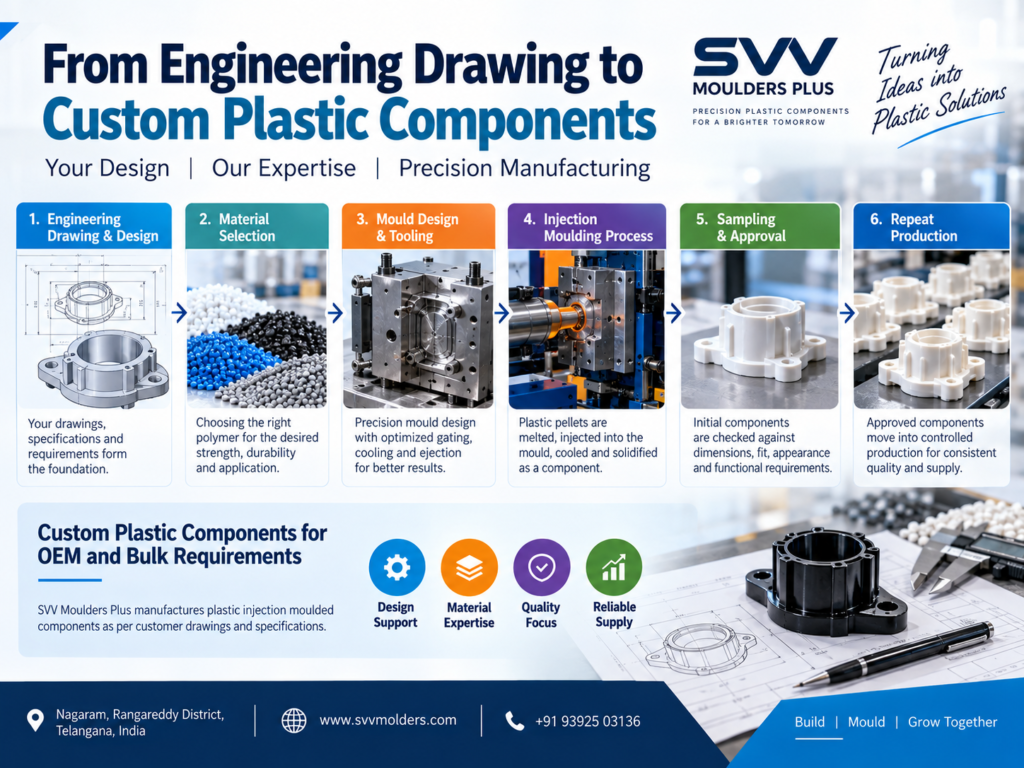
From Engineering Drawing to Custom Plastic Components
In OEM injection moulding, the engineering drawing and three-dimensional model form the technical baseline for tooling and production. The drawing should clearly communicate dimensions, tolerances, interfaces, appearance requirements and features that are critical to assembly or function. Where a specific material grade is mandatory, identifying it explicitly can reduce ambiguity during quotation, tooling and production.
SVV Moulders Plus states on its Products page that its plastic injection moulded components are developed according to customer drawings and specifications for OEM and bulk requirements. This makes the SVV Moulders Products page a natural internal-link opportunity when discussing drawing-based manufacturing and custom plastic components.
Material selection affects both processing and finished-component performance. Different thermoplastics can require different melt temperatures, mould temperatures, drying conditions and processing parameters. Covestro, for example, publishes resin-specific injection-moulding conditions and notes that hold-pressure recommendations can vary depending on component geometry, machine and mould.
Material preparation should therefore follow the requirements of the selected resin rather than a single rule for every plastic. Some moisture-sensitive materials require controlled drying before processing; Covestro’s published processing information for specific polyurethane and polycarbonate materials explicitly requires drying to defined moisture levels before injection moulding.
Design-for-manufacturability review is equally important for custom plastic components. Features such as wall thickness, ribs, bosses, draft and material flow need to be considered with the moulding process in mind. Autodesk’s current plastic-design tools specifically provide manufacturing-oriented guidance around material selection, wall thickness, draft angles, rib design and material flow.
Gate position, cooling layout and feed-system design also matter because they influence how plastic enters and solidifies inside the cavity. Autodesk Moldflow is specifically designed to analyze cavity filling, feed systems, cooling, material selection and warpage, while Autodesk guidance notes that gate location can influence moulding behavior and warpage.
Tooling converts the approved geometry into production hardware. A tooling discussion should therefore cover cavity count, gating concept, parting line, ejection, cooling, expected maintenance and tool ownership or storage responsibilities where applicable. Because feed and cooling layouts influence manufacturability and component quality, these matters are better discussed before tool construction than after repeated moulding problems appear.
Sampling is where design intent meets the actual manufacturing process. Initial components should be reviewed against agreed dimensions, fit, appearance and functional requirements, with deviations recorded and corrective actions controlled. Once the sample is approved, both parties should be clear about which drawing revision, material specification and inspection criteria form the production baseline.
This is where OEM injection moulding becomes a controlled manufacturing relationship rather than a one-time component purchase. A customer-requested engineering change, tooling correction and process adjustment should be distinguished from one another because each can affect the approved production condition and subsequent repeat orders.
What OEM Buyers Should Evaluate in a Moulding Supplier
When evaluating OEM injection moulding, buyers should look beyond machine availability. A useful supplier review should examine how drawings are assessed, how material requirements are confirmed, how tooling is developed or maintained, how samples are approved, how process conditions are controlled and how parts are inspected against agreed requirements.
The official SVV Moulders Plus website states that its facility includes plastic injection moulding machines and that quality checks are performed as part of manufacturing to support dimensional accuracy and consistency. Its Products page also states that plastic components are manufactured for OEM and bulk requirements according to customer drawings and specifications.
These verified points create a natural internal-link opportunity to the SVV Moulders Infrastructure & Quality page. They do not, however, justify assuming certifications, machine tonnage, specific tolerances or production capacities that are not stated in the published information.
Procurement teams should also ask how an injection moulding supplier manages material identification, drying where required, start-up conditions, in-process checks, mould condition and final inspection. The purpose is not to demand unnecessary paperwork; it is to establish whether the manufacturing controls are appropriate for the technical and commercial risk associated with the component.
Dimensional requirements deserve particular attention. Buyers should distinguish critical functional features from general dimensions instead of automatically applying unusually tight tolerances everywhere. Manufacturing-oriented plastic design tools consider geometry, material, wall thickness and moulding behavior together because these factors can influence manufacturability and final component condition.
Critical-to-function features may include interfaces associated with assembly, alignment, sealing, clearance or component performance. Identifying these features during supplier discussions helps the OEM and manufacturer focus tooling, processing and inspection attention on the dimensions that matter most to the final application.
Communication is another practical selection factor. Buyers should establish who approves drawings, who can authorize engineering changes, how deviations will be communicated and what revision information must accompany repeat purchase orders. For custom plastic parts manufacturing, structured revision control can reduce the risk of an outdated drawing becoming the basis of a later batch.
SVV Moulders Plus identifies its manufacturing location as Nagaram, Rangareddy District, Telangana, India. OEM buyers in Hyderabad and surrounding industrial areas may therefore consider proximity alongside technical fit, quality requirements, commercial terms and logistics. The SVV Moulders About Us page is the natural internal-link destination for verified company background and location information.
Quality, Tooling and Repeat Production for OEM Components
Quality in OEM injection moulding should be built around agreed component requirements rather than treated only as an activity performed after production. Process stability begins with the intended material, mould condition, suitable processing settings and a repeatable cycle, while inspection verifies whether the resulting component meets defined acceptance requirements. Autodesk’s Moldflow platform similarly treats material choice, process settings, cooling, feed-system design and final part quality as interconnected variables.
Cooling deserves particular attention because the moulded part must solidify sufficiently before successful ejection. Autodesk defines the cooling stage as the period in which the component remains in the mould until it can be ejected and notes that cooling is commonly the longest portion of the moulding cycle.
Cooling should therefore not be optimized only by trying to make the cycle as short as possible. Autodesk’s moulding resources connect cooling behavior with part quality and warpage, and its software specifically evaluates cooling-channel efficiency as part of injection-mould design and process optimization.
Tool condition also matters during repeat manufacturing. Gates, vents, ejection features, cavity surfaces and cooling systems form part of the working mould, so maintenance and engineering changes should be managed rather than treated informally. Autodesk also notes that excessive friction between the component and mould surfaces during ejection can damage the part or make ejection difficult.
Inspection planning should reflect the risk and function of the component. Visual checks may be used to identify obvious moulding abnormalities, while dimensional inspection can verify selected features against the approved drawing. Moulding-analysis tools themselves focus on potential issues such as short shots, air traps, weld lines, sink marks and warpage, illustrating why different defects can originate from different aspects of part, mould and process design.
Repeat orders are where an OEM plastic components manufacturer demonstrates process discipline. Production should work from the current approved drawing and material requirement, while procurement should reference the correct revision and communicate important quantity or schedule changes.
Where a change to the mould, specified material or component geometry could influence fit, function or appearance, the OEM and manufacturer should determine whether new samples or renewed approval are necessary before full production resumes.
For OEM injection moulding, repeatability is therefore a combination of tooling, documented requirements, controlled processing, inspection and communication. Buyers evaluating long-term supply should ask not only whether the first sample is acceptable, but also how the approved requirement will be maintained across future manufacturing batches.
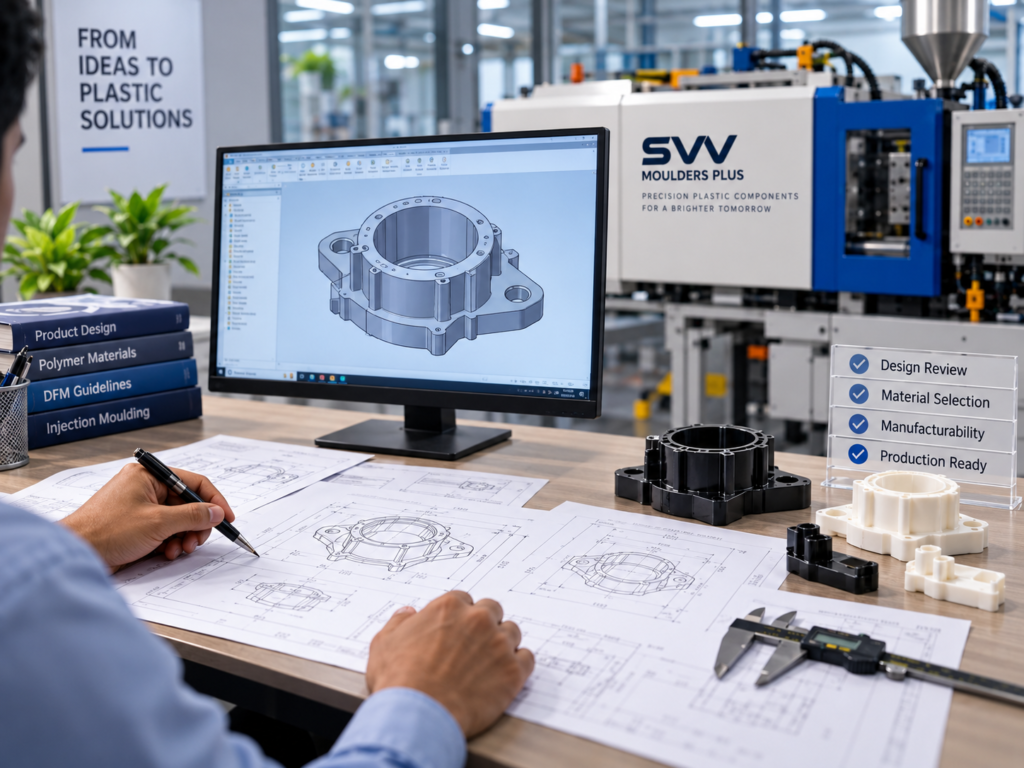
Choosing an OEM Moulding Supplier for Contract Manufacturing in India
Companies searching for contract injection moulding India services should begin with technical fit rather than a generic supplier shortlist. A contract manufacturer needs enough information to understand the drawing, material, geometry, production quantity and quality expectations, while the quotation should clearly identify the agreed scope for tooling, sampling, production, inspection, packaging and secondary operations where applicable.
When comparing an OEM moulding supplier, buyers should also assess the quality of the technical review. Questions regarding draft, gate position, wall thickness, critical tolerances or material behavior can be useful because these are recognized considerations in plastic-part manufacturability and moulding-process analysis. Autodesk’s manufacturing tools specifically evaluate design elements such as draft, thickness and material flow before production.
Early clarification is generally preferable to discovering a design conflict after tooling has been manufactured. Autodesk positions moulding simulation and manufacturability analysis partly as methods for identifying part-quality and mould-design issues earlier, including potential problems associated with cooling, gating and warpage.
SVV Moulders Plus states that it supports OEM and bulk manufacturing requirements and produces custom moulded components according to customer drawings. Buyers can therefore use the SVV Moulders Products page to review its published plastic-moulding offering, the Infrastructure & Quality page for stated manufacturing information, and the Contact page for quotations and OEM manufacturing enquiries.
For procurement teams, OEM injection moulding works best when the enquiry package is complete. Providing the current engineering drawing or three-dimensional model, specified material or required material properties, expected order quantity, forecast demand where known, critical dimensions, appearance requirements, application information and relevant approval requirements gives the supplier a more useful basis for technical review.
Buyers should also clarify commercial ownership and change-control expectations before repeat production. Tool ownership, maintenance responsibility, drawing revisions, permitted material substitutions, order quantities, lead-time expectations and requalification after significant changes can all affect the long-term supplier relationship.
These factors are particularly important when the requirement involves custom plastic components that will be reordered over time. Clear technical baselines and purchasing responsibilities help procurement, engineering and manufacturing teams work from the same approved requirement rather than relying on informal assumptions.
Businesses evaluating OEM injection moulding for custom plastic components, drawing-based manufacturing, contract manufacturing, bulk requirements or repeat production can contact SVV Moulders Plus with a defined technical enquiry. The company’s official Contact page specifically invites quotations and OEM manufacturing requirements, so providing drawings, specifications, expected quantities and relevant material or application information gives the manufacturer a clearer basis for reviewing the requirement.